Germany’s shrinking workforce means we will pay more, work longer and get less from the state. Japan and South Korea already show which businesses that shift creates.
In light of Germany’s recent pension reform, I took a deeper look at how the pension system actually functions. The data makes the trajectory clear and highlights the opportunities that could result. This post expands the view to other countries and examines the business and investment implications across markets.
”Die deutsche Rente” 101
The German pension system uses a specific formula to determine your payout:
Monthly Pension = Earnings Points × Pension Type Factor × Current Pension Value
I don’t want to get into the minute details, but here is a simple example:
A worker earning the average wage for 40 years accumulates 40 points. With a current pension value of €40.79:
Monthly pension = 40 × 1.0 × €40.79 = €1,631.60
The Funding Reality
The system is financed through two channels: direct amounts from paychecks and a massive government subsidy.
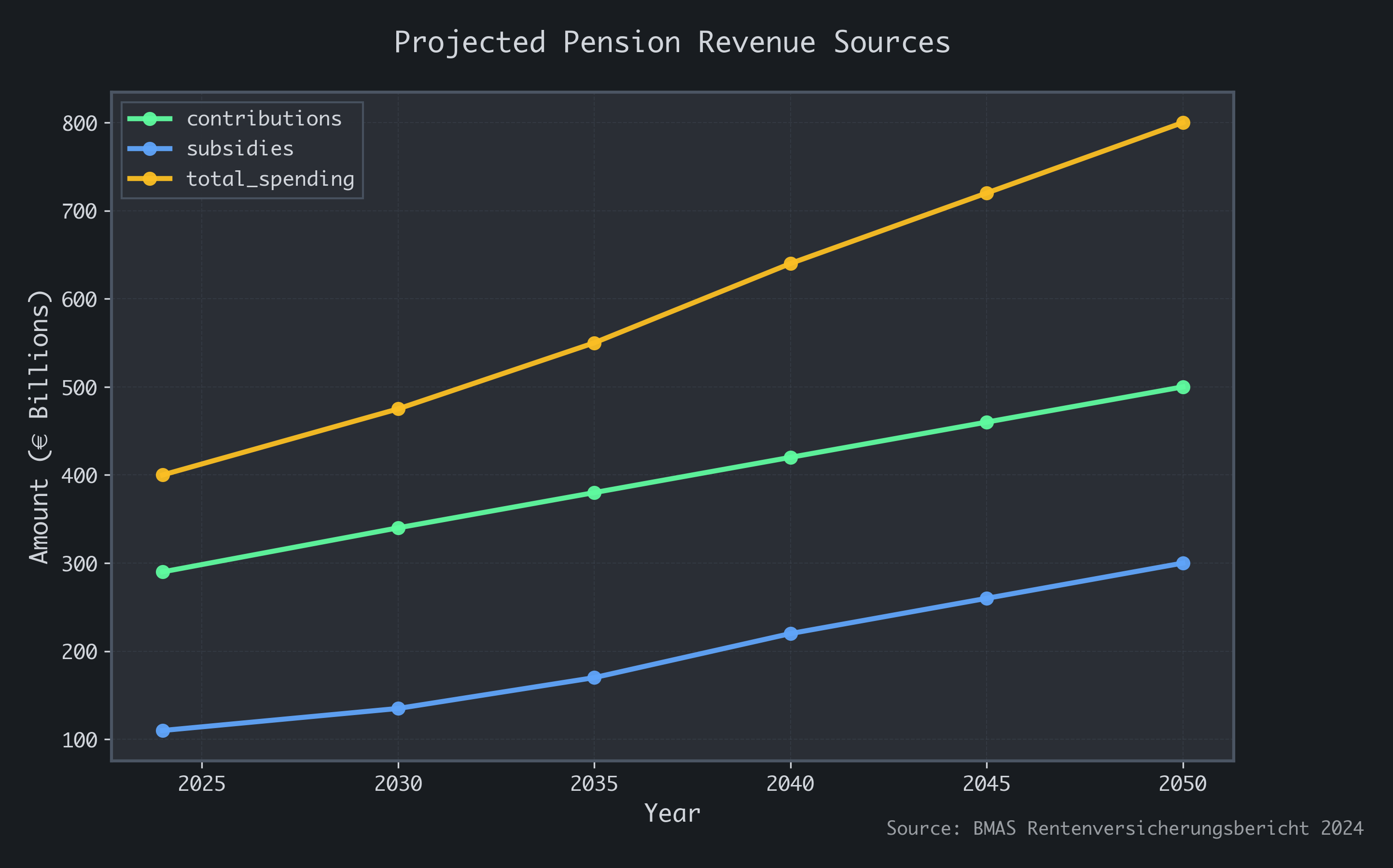
Total spending is currently ~€390B annually.
- 72% comes from contributions (18.6% of everyone’s gross salary).
- 28% comes from federal tax subsidies (€110B).
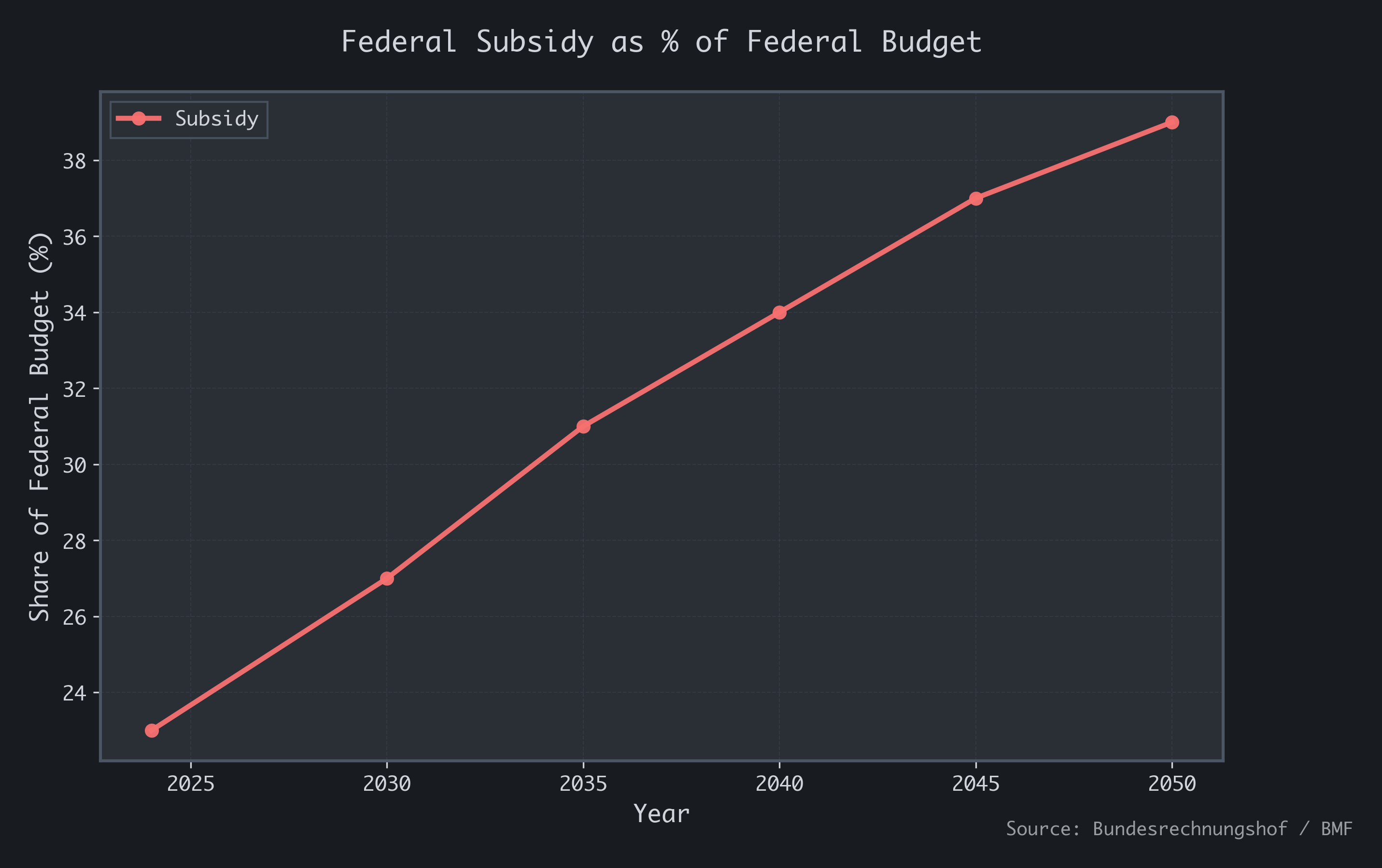
We are fucked. Instead of being able to spend all that lovely tax money on moving the country forward, we have to pay the elderly, which will in turn lead to less tax money to pay the elderly from in the future. Downward Spiral activated.
The Demographic Shift
The core challenge is demographic. I mean LOOK at this graph.
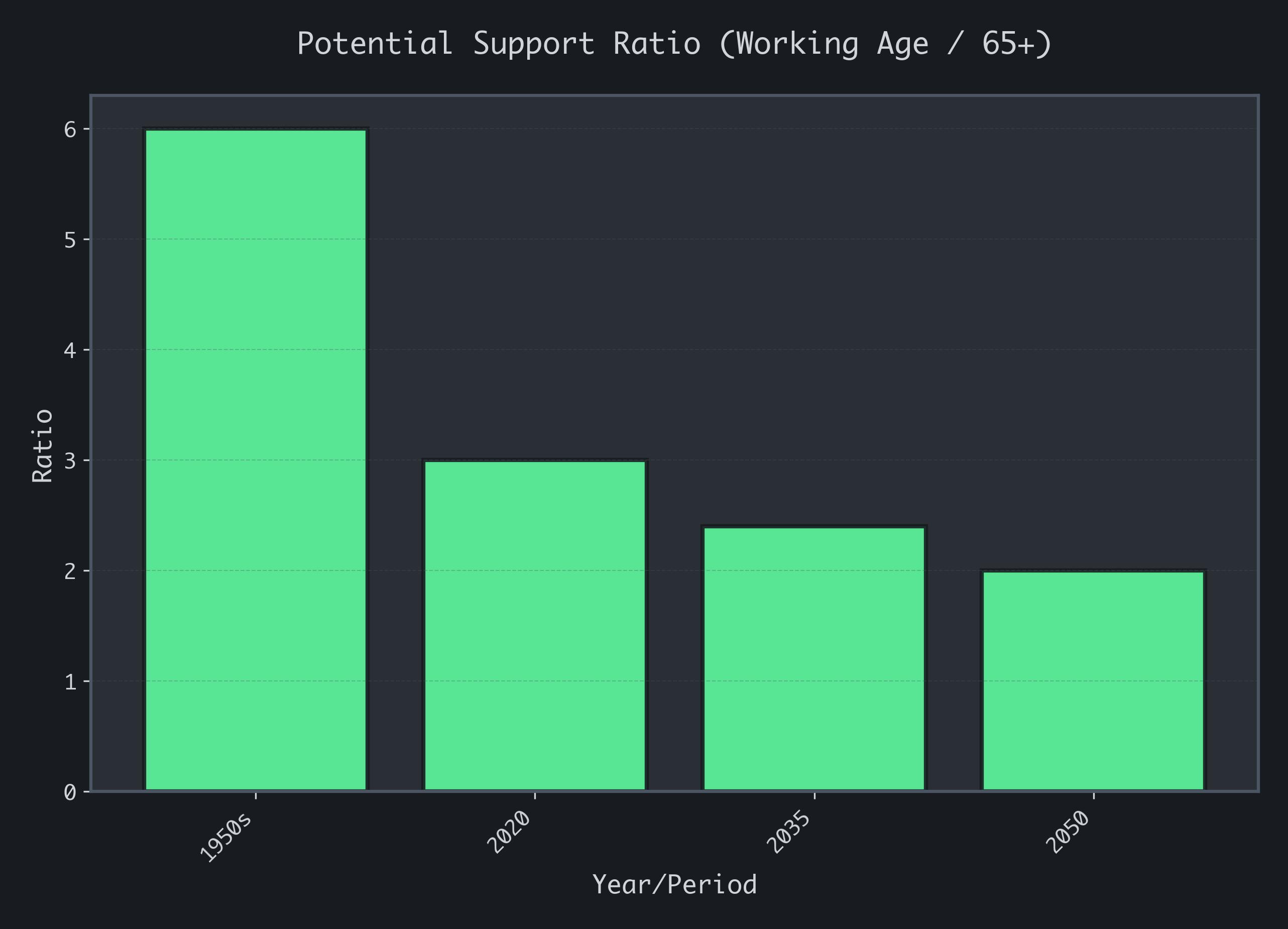
While we had 6 workers per pensioner in the 1950s, we will have 2 workers per pensioner in 2050.
Rentenpaket II (December 2025)
So, does this actually fix anything? Let’s look at what Merz and Co have come up with:
The Good News (For Retirees)
They are keeping the 48% pension level locked in until 2039 (pension level is the percentage of your salary that you get as a pension).
The Catch (For Everyone Else)
This “stabilization” is basically just putting the bill on the credit card. The demographic math hasn’t changed, we just decided to ignore it.
- Taxpayer Bleed: Because contribution rates are going up, the government acts as the guarantor. This means federal transfers, paid for by your taxes, will skyrocket to cover the gap.
- Generation Capital: Integrating capital markets is finally a step in the right direction. Moving away from pure hand-to-mouth financing. But the effect is a drop in the ocean. Even with billions invested, projections show it will only lower the contribution rate by a tiny ~0.3-0.4% in the long run. Source: Bundestag Drucksache 20/11898
International Comparisons
I mean we are not the only ones. Let’s look at other countries, especially those further along in the demographic takeover of ageing societies.
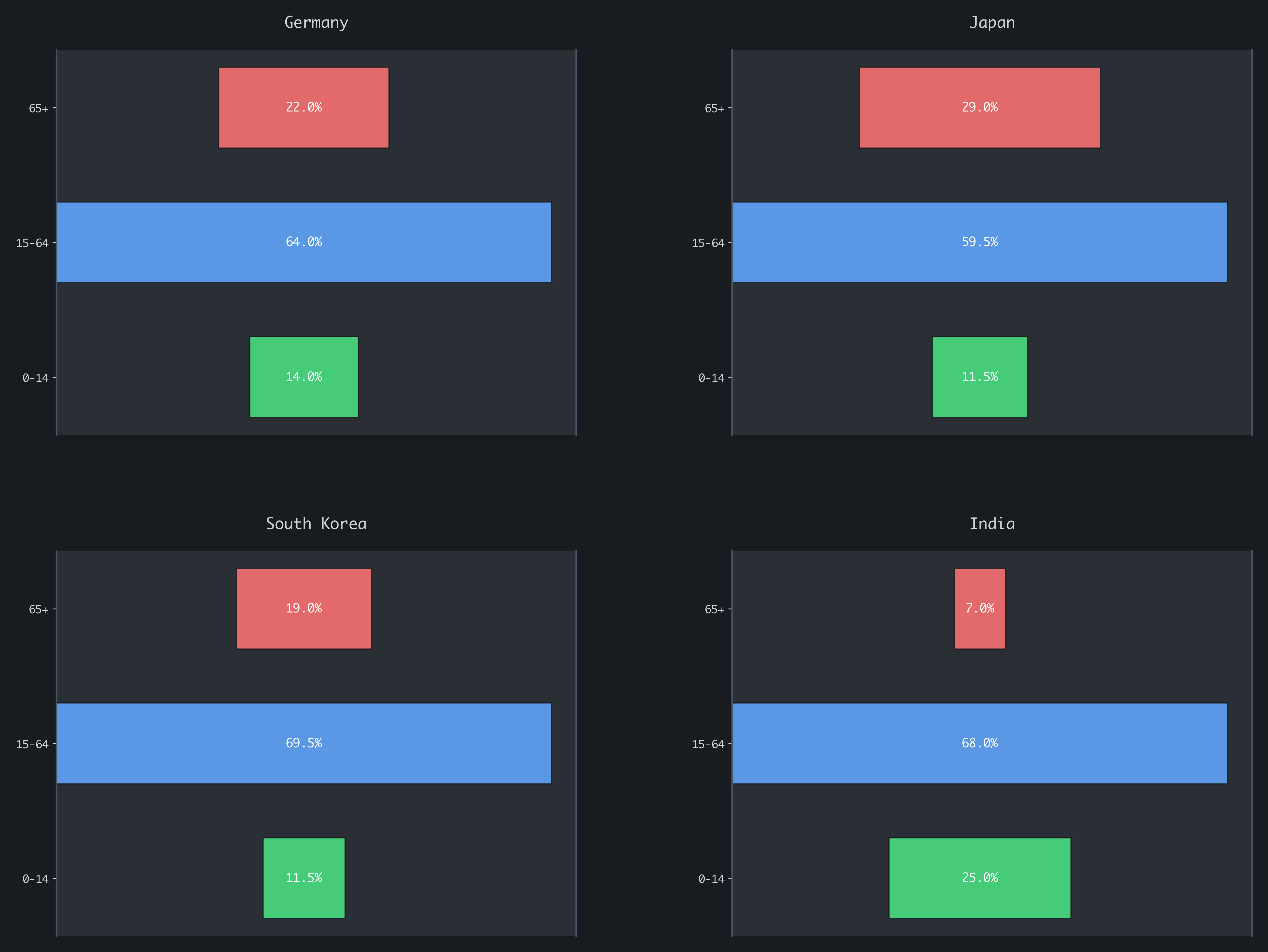
Source: Wikipedia. I added India as a reference.
Asia’s Demographic Frontrunners
Japan (Oldest Country) and South Korea (Lowest Birth Rate) show us where this path leads.
How they are adapting:
- Automatic Benefit Cuts: Both use a “macroeconomic slide” to automatically lower payouts as the population ages.
- Later Retirement: Pushing ages from 60 to 65, with proposals for 70.
- Private Responsibility: A heavy shift toward private pension pillars.
The Result: System stability is achieved, but at the cost of significantly lower state benefits for younger generations.
Projections for Germany
As Germany follows the path of Japan and Korea, the next two decades will define a new normal:
- The State Retreats: Public pension levels will inevitably drop below 45% as Baby Boomers retire.
- Costs Rise: Contribution rates will climb past 22%, increasing the burden on workers.
- Work Lives Extend: Retirement at 67 won’t hold; expect the age to creep toward 70.
- Private Funding Takes Over: The gap between state support and actual needs will force a shift to a three-pillar system where private investment is mandatory.
In short: Pay more, work longer, get less from the state.
Market Opportunities
The shift from state-funded to partially self-funded retirement creates significant market opportunities.
The “Time Machine” Hypothesis: Japan and South Korea are roughly 10-15 years ahead of Germany in their demographic transition. By looking at the business models that have already scaled successfully in these markets, we can predict what will likely emerge in Germany.
The following solutions are not just theoretical—they are already successful businesses in Asia.
1. Pension Technology & Financial Services
Solutions & Proven Models:
- Robo-advisors optimizing across pillars
- Blueprint: WealthNavi (Japan) – Reached ¥1.3T AUM by automating tax-efficient retirement portfolios (“Robo-NISA”).
- Blueprint: Money Design / THEO (Japan) – Branded investment as a “lifestyle” service to capture younger demographics early.
- Real-time benefit projection & support tools
- Blueprint: Fujitsu (Japan) – Deployed AI chatbots for the National Pension Service to handle massive inquiry volumes.
- Pension aggregation & management platforms
- Germany’s early movers: Penzilla (Corporate pension SaaS) and Ginkgo (bAV digitization).
- Longevity insurance products
- Fractional real estate for retirement income
2. Extended Career Infrastructure
Solutions & Proven Models:
- Senior-focused gig platforms
- Blueprint: Mercari (Japan) – Launched “Mercari Hallo” to connect retirees with short-term gig work.
- Blueprint: Matchbox Technologies (Japan) – Partnered with municipalities (e.g., Sado Island) to digitize seasonal jobs for seniors.
- Flexible employment matching
- Blueprint: RGF Connect (Recruit Group) – Specialized in placing “active seniors” in part-time roles.
- Germany’s early movers: Senior Connect (AI matching for 60+ talents).
- Reskilling programs for 55+
- Age-friendly workplace technology
3. Senior Housing & Care
Solutions & Proven Models:
- Pension-optimized senior living
- Blueprint: Tokyu Land (Japan) – The “Grancreer” brand proved that integrating luxury housing with on-site care is a scalable massive-market product.
- Tech-enabled care solutions
- Blueprint: Welmo (Japan) – AI for care planning to optimize insurance usage.
- Blueprint: Triple W (Japan) – “DFree” ultrasound sensors for incontinence, significantly reducing caregiver burden in facilities.
- Blueprint: Sage Sentinel – AI monitoring to prevent falls for seniors living alone.
- Germany’s early movers: Careship and Pflege.de.
- Reverse mortgage platforms
- Co-housing models
4. Wealth Transfer Services
Solutions & Proven Models:
- Digital estate planning platforms
- Blueprint: AGE Technologies (Japan) – Created so-zo-ku.com to digitize the entire inheritance and tax process.
- Blueprint: Zweispace (Japan) – Using blockchain for automated wills and trusts (“Pitashin”) to handle complex property rights.
- Germany’s early movers: DGLegacy.
- Accessible family office services
- Inheritance advance products
- Tax optimization tools
December 13, 2025